

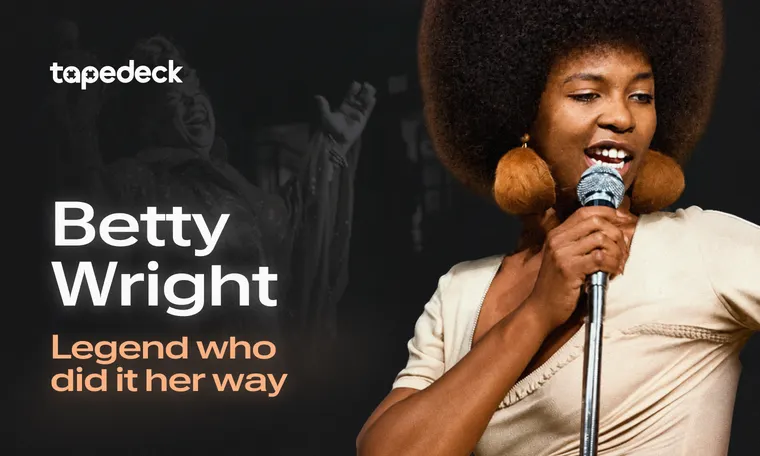
In 1988, Betty Wright did something no woman had ever done: she earned a gold record on a label she owned. The album was Mother Wit. She’d launched Ms. B Records three years earlier, after deciding that if anyone was going to profit from Betty Wright's work, it ought to be Betty Wright. She also ran her own publishing company, Miami Spice. This was an artist who understood ownership as survival decades before it became a TED talk.
You likely know Ms. Wright’s signature tune, “Clean Up Woman.” Even if you think you don't, you do: its guitar riff has been sampled by Mary J. Blige, SWV, Afrika Bambaataa, and Chance the Rapper, among others. She cut it in 1971 when she was just 17. It went to No. 2 R&B, No. 6 pop, sold over a million copies, and earned the first of Betty’s six Grammy nominations (she won in 1975 for "Where Is the Love"). She also did amazing work with other artists: she produced Joss Stone's Grammy-nominated Mind, Body & Soul, arranged the harmonies on Gloria Estefan's number 1 hit "Coming Out of the Dark," mentored a generation, and made her last album with The Roots. She had a whistle register most singers can only dream about. She was, by any measure, a legend.
But the gold record on her own label is the one that matters to us — because Betty Wright was running the Tapedeck thesis forty years before Tapedeck existed. She just had to do it the hard way.
So I'm glad to say her catalog is now on Tapedeck, where every play pays a minimum of a penny and Betty’s fans can pay her even more if they so desire. That's worth dwelling on for a second, because of how thoroughly it inverts the industry Betty had to fight. When I look at a Warner Bros. royalty statement for my own band, the number that comes back for a stream is some fraction of a penny. Betty spent her career refusing to accept fractions of a penny on principle. Now her music lives on a service built on the same refusal.
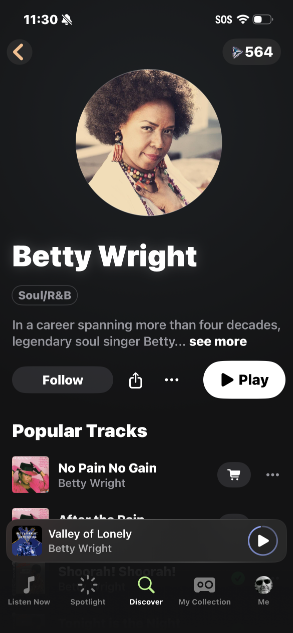
I'll be honest about what I can't claim. We didn't sign Betty Wright — she passed in 2020, at 66, far too early. What we did is reach an agreement with her estate, stewarded by her family, to bring her catalog to a platform built on the premise she lived by. That distinction matters to me. The worst thing a streaming service can do with a legacy artist is treat the catalog like inventory — a few hundred more tracks to pad the numbers while the actual humans who inherited the work see almost nothing. We're not doing that. Every play of a Betty Wright track on Tapedeck pays her estate 80% of whatever a fan spends, with a penny per stream as the floor and no ceiling at all. If you think "Tonight Is the Night" is worth more than a dollar to own — and it is — you can say so with your wallet.
We're announcing this now, in time for Juneteenth, and that timing isn't an accident. Betty Wright was a Miami artist, a Black woman who built her own house in an industry that wasn't designed to accommodate her, and who succeeded anyway. Celebrating her on a weekend about freedom and self-determination feels less like marketing and more like the only honest way to do it.
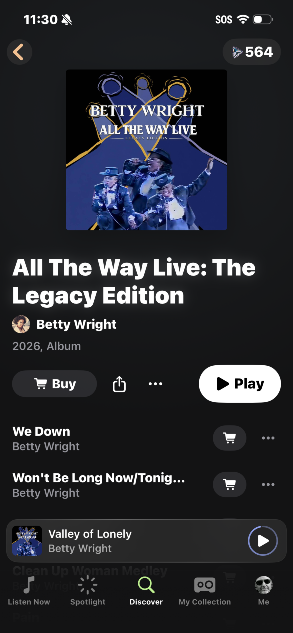
So go listen. Start with "Clean Up Woman" if you've somehow never heard the whole thing, then "Where Is the Love," then "No Pain (No Gain)," then keep going. The catalog Betty Wright’s estate has made available to Tapedeck includes the exclusive release of Betty's 1989 concert at London's Hammersmith Odeon, All The Way Live (The Legacy Edition) was originally released on CD in 1992 and is now is available to stream for the first time ever exclusively on Tapedeck for the next six weeks.
The first 30 seconds of every track are free; after that it's a penny, and 80 cents of every dollar goes where it belongs. That's the whole pitch. Betty Wright would've understood it immediately — she figured it out in 1985.
Welcome to Tapedeck, Ms. B.