
By Ignas Danielius
At Zedge we learn and improve by running tests. Lots of tests! We build hypotheses, then validate them. Recently we ran a test so bold that we decided it merits a blog article. At firste could not believe the results, but it eventually became clear: we have to kill the banner. Mobile banners have been the undisputed king of mobile real estate – mostly because they fit everywhere and generate minimal friction for users.
But with the rise of high friction formats such as interstitials and rewarded video, banners started losing traction. And as those high-friction formats evolved, the banner remained simple, even primitive. The only recent “innovation” has been banner’s adaptability to screen size. Publishers pushing standard refresh rates (30s - 15s) to 10s - 5s could have burned the format as advertiser value (CTR and conversions) plummeted with faster refreshes.
The idea to experiment with eliminating banner ads sprang from a conversation with Felix Braberg, who made it clear they’re rapidly losing relevance. As highlighted in his article, “Banners: The Walking Dead of Mobile Ads,” “banners are steadily declining as a meaningful source of monetization, contributing less and less to overall ad revenue."
Before we dive into our experiment’s methodology and results, it's important to understand why multiple ad formats exist and how the publishers using multiple formats win.
A publisher’s goal is maximizing LTV. Using multiple formats leads to higher ARPDAU and consequently higher LTV (for example: you can get less value from adding an extra interstitial as compared to adding an app open ad instead (Google Admob template).
Multiple formats allow publishers to maximize advertiser spend on the bundle id as many advertisers are buying multiformat ads. Networks such as Google even transform advertiser ads into multiple formats automatically. Thus, maximizing LTV is about making sure that you as a publisher sell what people are buying.
Methodology:
Test conducted on android between Dec 8th, 2025 and Jan 26th, 2026 (51 days). We used the following key performance indicators to evaluate impact: Engagement, Retention, North Star, LTV, IMPS/DAU, ARPDAU, Impressions.
- Test variants:
- A - no banner (test variant – All banners were removed entirely, leaving the UI clean.)
- Control Group -- no change
2. Sample size: 17.7M uniques
- A - 8,868,506
- CG - 8,870,775
Results:
The results of the experiment challenged the traditional "more ads equals more money" philosophy. By removing the banners, we observed the following:
- Engagement - 0.34% increase (99% confidence)
- Retention - no statistically significant variation
- North star 1.77% increase (99% confidence)
- LTV - 1.0% increase (99% confidence)
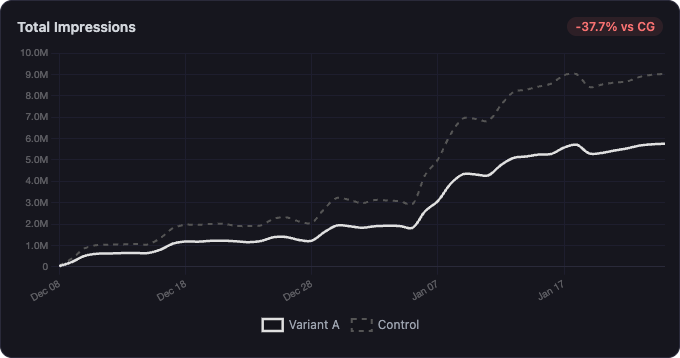
- Impressions - 38% decrease
Conclusions:
The 320x50 banner is a relic of an era when "impressions" mattered more than "intent." Our findings indicate that:
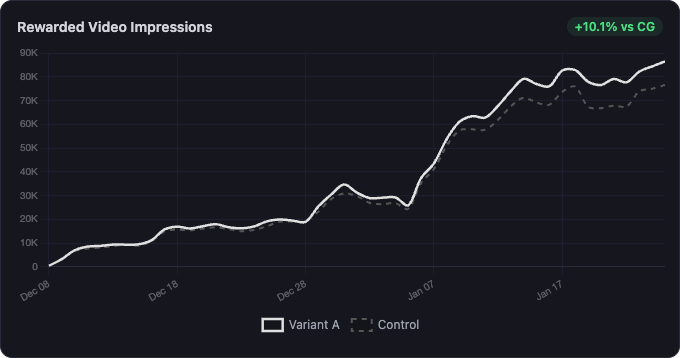
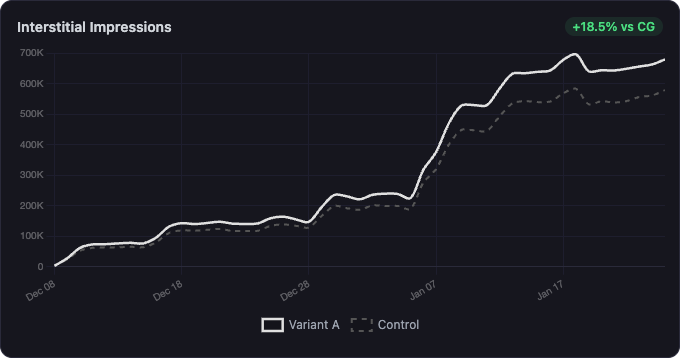
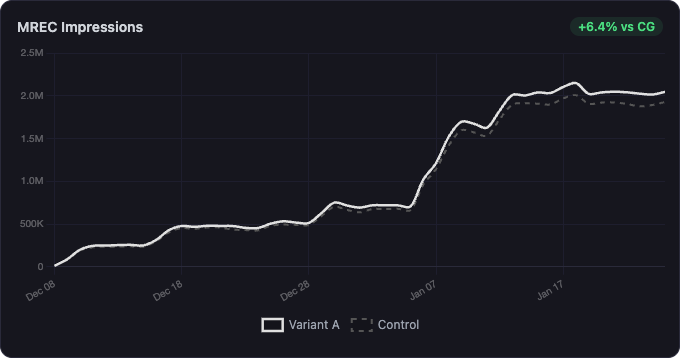
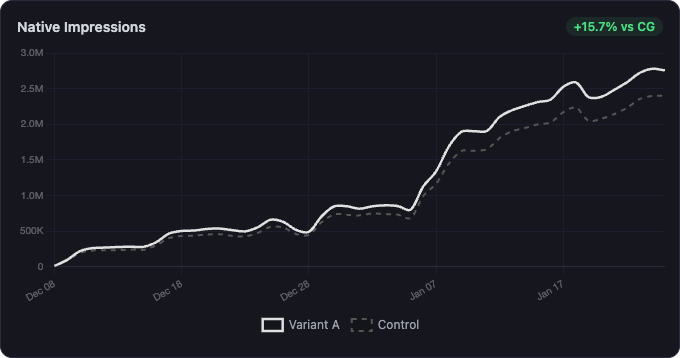
- Cannibalization is Real: Small, low-value banners often distract users from higher-value actions within the app. Aside from that, removing low value impressions leads to greater fill rates for higher value impressions. (Advertisers target a specific app rather than specific format) Disabling banners led to an 18% increase in Interstitial impressions, a 6% increase in MREC impressions, a 16% increase in Native impressions and a 10% increase in Rewarded Video impressions.
- UX is a Revenue Driver: A cleaner interface leads to higher user satisfaction, which translates into better long-term monetization.
- Significance Matters: With a 99% confidence level, we can conclude that the 1% LTV gains and 1.77% north star improvement were not a fluke.
All in all, it's important to focus on total revenue rather than format-specific revenue, as improving one format can deteriorate another, leading to an overall decline in performance.
While the banner might still have a place in certain utility apps, for engagement-heavy products such as Zedge Wallpapers and Ringtones, it may finally be time to retire this tiny strip of pixels.
Graphs:
- Total impressions - decreased by 38%
- Interstitial impressions: increased by 18%
- MREC impressions: increased by 6%
- Native impressions: increased by 15%
- Rewarded Video impressions: increased by 10%